What's Your Revenue Goal for the New Year?
Don't start the new year not knowing where you're headed.
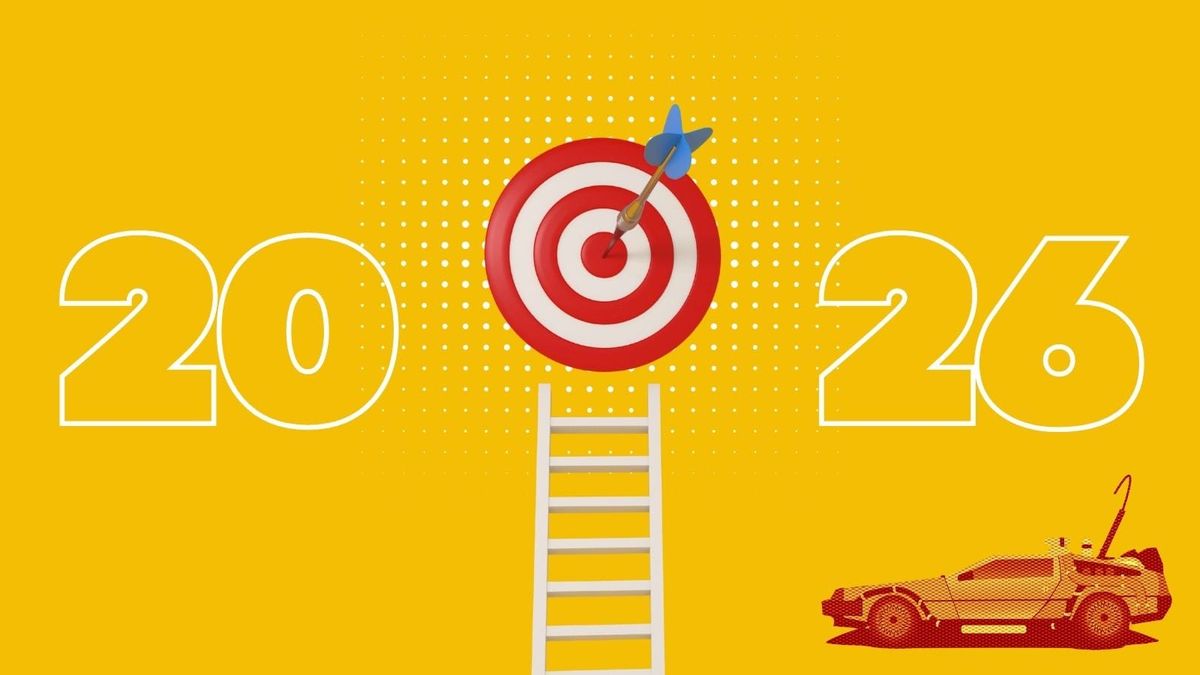
In a memorable scene from the 1985 comedy Back to the Future, Christopher Lloyd’s Doc Brown unveils his time machine—a gleaming DeLorean—and, as he prepares to demonstrate it for his young friend Marty McFly (Michael J. Fox), turns and says: “If my calculations are correct, when this baby hits eighty-eight miles per hour, you’re gonna see some serious s---.”
Ah, the joys of time travel.
Isn’t that the magic trick the world is about to perform as we leave one year and step instantly into another?
So apropos of this New Year’s Eve, and in true Doc Brown fashion, let me breathlessly tell you one last thing: Before the stroke of midnight, there’s one question you must urgently ask yourself—and answer:
What is my revenue goal for the year ahead?
Setting a goal like that is a kind of time travel (sans the DeLorean). You name a clear future so you can start building toward it on purpose. Punching in that number doesn’t guarantee you’ll arrive at your destination, but it will stop you from wandering.
And consider the alternative. If you greet the new year without a revenue goal, you’re doing the business version of getting on a bus (or Doc Brown’s contraption) without knowing where it’s headed.
And yes, I know. Setting a number can feel scary. It’s hella intimidating to face the scoreboard when you’re starting to fall behind, or when the gap between your intention and reality widens. That fear is exactly why many business owners avoid the question altogether. But avoidance is not the answer. The answer is to set a goal that fits your business stage—and to treat the goal as a direction, never a verdict on your worth.
Your Revenue Goal Depends on the Stage You’re In
If this year your revenue was around $10,000 or less, I’m not even thinking about tripling your revenue. At this level, you’re trying to prove you can sell consistently and build momentum. A better question is:
How do I quintuple my revenue?
Because the truth is, at $10,000 a year, you need more than small tweaks. You need clearer focus, more consistent selling, and a stronger grip on who you help—and what you help them do.
If your business brought in about $30,000 this year, congratulations—that’s really something. But in most cities right now, it’s not enough to create real stability. In that case, it is completely reasonable to ask:
How do I triple my revenue and start approaching $100,000?
And if you’re around $75,000 in annual revenue, your challenge is different again—not because you’re failing, but because you’re close enough to real traction that the next jump often requires more than mindset and grit. It can require structural changes: tightening the offer, raising prices, improving follow-up, and building simple systems so growth does not break you.
The Startup Phase: Here There Be Dragons
Here’s something I want more people to understand:
For most mom-and-pop businesses—especially solopreneurs and microbusinesses with one to three people—the startup phase is not a few months. It’s the time it takes you to advance from zero to about $250,000 in revenue (though this dollar value varies widely by industry).
This is a bewildering and messy stage of business development, when you’re building the plane as you fly it. You’re selling, delivering, handling problems, and learning everything the hard way—often without a team, without deep cash reserves, and without much room for error.
And it’s also the phase where support is strangely hard to find.
Why? For three reasons.
First, and let’s be honest, it’s the hardest phase. You’re planting a seed and watering it every day, hoping it becomes something that can sustain you. But sadly, we know that most mom and pop startups fail. Is it any surprise then that most organizations like local, state and federal governments, including SBDCs, and CDFIs, find it more productive to invest in more established businesses?
Second, many microbusiness owners at this stage simply don’t have extra money to invest in help, tools, or guidance. It’s truly unfortunate that the people who most need assistance can’t afford to procure it.
Third, early-stage microbusiness founders are still building the skills and experience that growth requires and they may not be ready to take advantage of the few resources available. Selling, pricing, positioning, operations are things most people learn while already in motion, and when they start out they don’t know what they don’t know. This limits their ability to truly leverage available help.
So if you’re in this phase, and it has felt lonely or confusing, I want you to hear me clearly:
Your bold revenue goal is not a pipe dream—but it does have to be grounded.
It’s not a pipe dream to quintuple from $10,000.
It’s not a pipe dream to triple from $30,000.
It’s not a pipe dream to grow from $75,000 to over $200,000.
But the goal has to be real for your business and your life. Not based on what sounds impressive, based on what you actually want to build, what you’re willing to do to build it, and the constraints you face in doing the building.
The good news is you don’t have to devise the entire plan today.
What you need today is to name your destination.
Tomorrow, next week, and next month, we can start building the path consistently, one practical step at a time.
Two Mindsets to Keep You Moving
Getting out of the startup phase as quickly as possible should be your top priority but it can be a daunting undertaking. Here are two essential pieces of wisdom to help you.
First: Have the courage to set an ambitious goal that’s still grounded in reality.
You may not be able to anticipate every step yet. But you don’t have to. You just have to choose a direction and make the commitment to learning your way forward. Though you may frequently doubt your abilities, choose to believe in yourself nonetheless. Have faith that you will find a way. As the old adage goes, whether you think you can, or you think you can’t—you’re right.
Second: Adopt a learning mindset.
If you try something and it doesn’t work, that’s not proof you can’t do it. It’s valuable information you can use. Think of it as one dead end in a large maze. Now you know not to go that way again. You adjust and try the next path.
That is how business works, life too.
Johann Wolfgang von Goethe said it best, “Whatever you can do or dream you can, begin it; Boldness has genius, power and magic in it.”
Your Assigment Before Midnight
So here’s what I want you to do before the clock strikes twelve:
Pick your revenue goal for the new year.
Don’t overthink it. Don’t shrink from the task. (No champagne until you do this?)
Write down your number.
Don’t step into a new year without knowing where you’re headed. Don’t start the year out at sea, at the mercy of the trade winds.
Setting a goal is your first step to seeing some serious results. Trust me, your future self will thank you.
Happy New Year my friend!
May your boldest wish for the New Year come true.