The Biggest Business Lesson I Ever Learned.
Hint: It was about marketing and learning to talk about what you do.

Let me tell you. When I launched my first little business in my late 20s, I didn’t know what I was doing.
I felt like a pilot flying through the Bermuda Triangle—thick cloud cover, gauges malfunctioning, flying blind. I couldn’t tell which way was north, south, east or west. It was all very (very) disorienting.
I think that’s how it goes for most, if not all of us, at the start of our small business journey. We don’t know what we don’t know.
All I knew back then was that I hated working for a big, cold corporation and wanted to strike out on my own and enjoy the freedom of being my own boss. I saw the opportunity to launch around the turn of the century and I took it.
Back in 1999 websites were still new but were clearly the future. So I learned HTML, and with my design skills, ventured to help businesses get online and take advantage of the new and glorious world of e-commerce.
My instincts were good, I just didn’t know what I was doing. I didn’t know how to execute on my ambition.
Soon I felt lost and discouraged.
Clearly, e-commerce was indeed the next big thing, and it would give small businesses a huge advantage, so why weren’t customers buying from me?
In retrospect, I know why.
I fell for the myth of “if you build it—they will come.” I also fell for another myth—that if you “build a better mousetrap, people will beat down your door” to buy one.
But they weren’t coming and they certainly weren’t beating down my door.
I racked my brain. What was I doing wrong?
Well, truth is—I was doing a lot of things wrong. I’m not too proud to admit that I made every beginner mistake in the book. I simply didn’t know any better. And I didn’t have anyone to teach me. Webinars, seminars and books just added to the confusion. Perhaps you can relate?
BUT…
Of all the whopping mistakes I made, let me tell you about the whoppingest of all!
I didn’t know what I was really supposed to be selling.
Put another way—I thought people buy goods for purely rational reasons. If people need a widget or service then they buy said widget or service. My 1999 logic went like this: Business owners need a website for their business. I build websites. Ergo they will buy a website from me. That’s the simplistic way I imagined the thought process of my potential customers went.
I was ignorant. About marketing.
I didn’t know that most people buy for irrational and emotional reasons, not merely for rational ones.
That doesn’t mean they don’t care about, say, the engine specifications of the car they’re looking to buy—things like engine size, horse power, gas mileage, acceleration, torque, braking, and steering. Blah, blah, blah. They do. But before they care about those things they need to feel excited; they need to be hooked emotionally.
Economists now know that there’s no such thing as “homo economicus,” economist lingo for a human being motivated by purely rational, narrow, cold, transactional logic. But hell, not even Mr. Spock on Star Trek was 100% logical. We all have a little dispassionate Spock in us, I’ll grant you, but most us make decisions more like the mercurial Captain Kirk.
So why do we go around barely scratching the surface of the buying motivations of our customers? Why do we ignore the kind of messaging that will really break through?
Don’t believe me? Have a look around. Look at the ads that small business owners create and pay good money for. Look at the things small business sales people say. They invariably appeal to the technical needs of the customer while completely ignoring the human emotions involved.
Here’s a few:
- Got milk?
- Have you been injured in an accident?
- Need a lawyer?
- How to make your business more bankable.
And those are some of the better ones!
Back when I was selling websites I didn’t understand that before I could talk about my better mousetrap, I had to talk or appeal to the emotions, both positive (and negative) of the human being I was trying to influence.
I didn’t realize that people didn’t really care about “getting a website”, they cared about making more money, about saving time, about finding more customers, and not leaving any money on the table, but above all, they cared about not being left behind, not missing out on opportunities, about success and peace of mind, and, to enjoy all that within the game of e-commerce, they cared about working with someone they could trust.
That said, you can now better appreciate what they really cared about in the context of “getting a website”:
- Ambition and desire;
- Fear and anxiety;
- Security and stability;
- Trust and dependence;
- Competitive drive and feeling like a winner;
- Relief and satisfaction;
- Enjoyment and engagement;
- and much, much more.
But there I was back in 1999 talking about the technical aspects of “getting a website,” completely oblivious to this deeper, subjective level of decision-making going on within my customers' hearts and minds.
Of all the things I had to learn as a kindergartener in the school of small business development, this one insight was the most powerful and eye-opening. I am often shocked at how many people in business don’t understand this powerful concept.
I can tell you from my own experience, and from my experience working with hundreds of small business people: when you stop making this enormous mistake, things will to change for the better.
And yes, it can happen for you.
So here’s your homework.
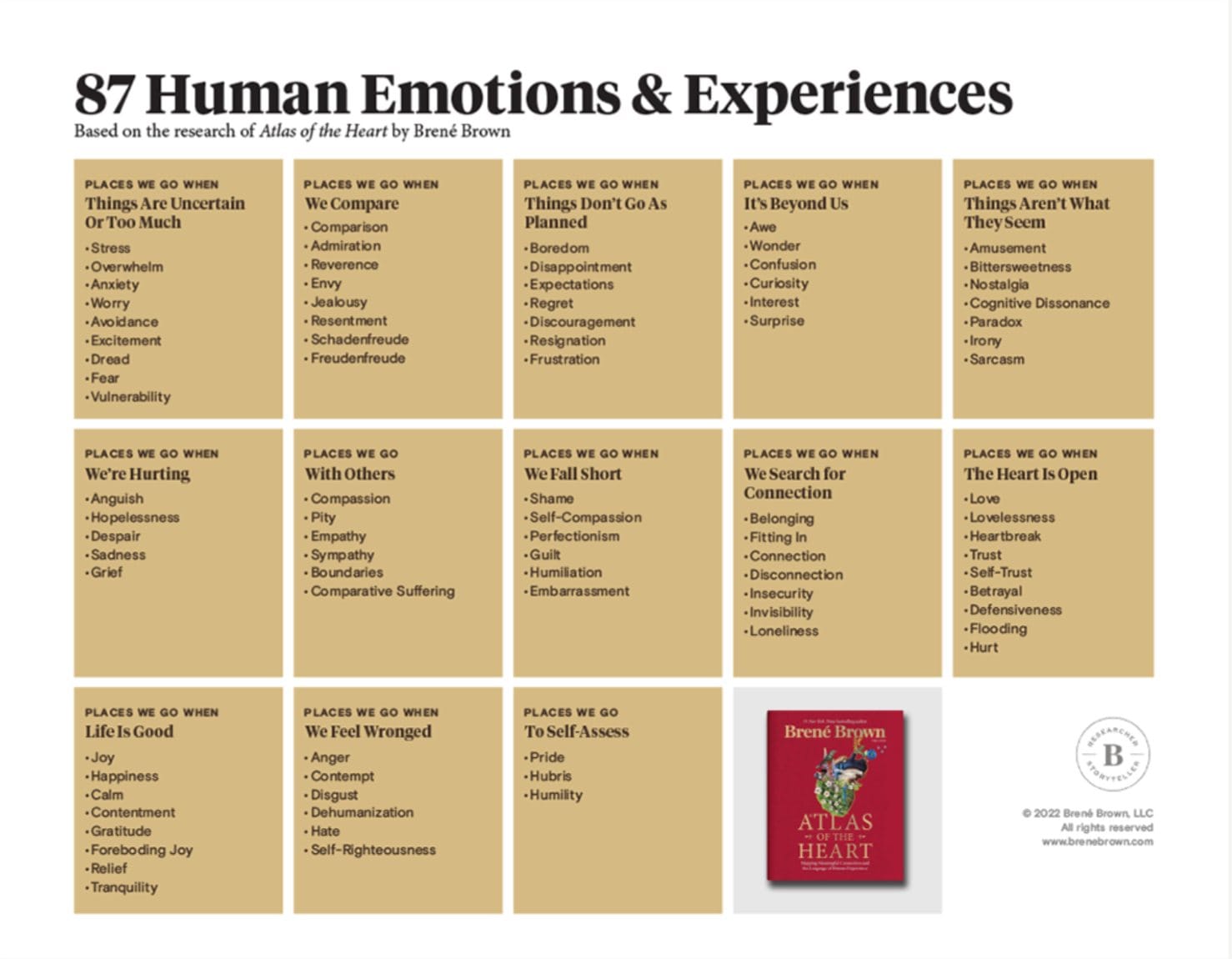
Check out Brené Brown’s list of emotions from her great book, Atlas of the Human Heart.
With that list handy, write down the top 5 emotions that your products or services may trigger in the customer.
And to really hammer home this lesson, let’s take a practical example:
Let’s say you’re an accountant or bookkeeper. What emotions do taxes and money issues touch inside your customer?
The top 5 might be:
Trust—because you can’t talk to just anyone about your money problems, can you;
Anxiety—because you worry about what you owe the IRS and all the horrible things that can happen if you don’t fix your money woes;
Confusion—because all this tax and finance stuff is so damn complicated;
Excitement— because you found a trusted person to help you and you might not be in as big a mess as you initially thought;
And Joy—Because you can now master your finances and your business can finally be, at long last, under control. Woohooo!
Do you see it now? Those emotions are what that accountant really sells, not merely financial statements or tax filings.
That accountant should at least change her messaging to address the emotional concerns of the customer before getting into details about how she’s the best, most experienced, accredited and knowledgeable accountant in her town.
Now it’s your turn.
Map the emotions your products or service can trigger in your customer and once you’ve done that, you’ll be in a much better position to communicate your value to that customer. And you’ll be much less likely to be ignored.
Need help applying this concept in your small business?
Get unstuck—book a FREE 30-minute coaching session with Danilo.