My Encounters with the Buddhist Monks on their Walk for Peace
Ten lessons for solopreneurs.
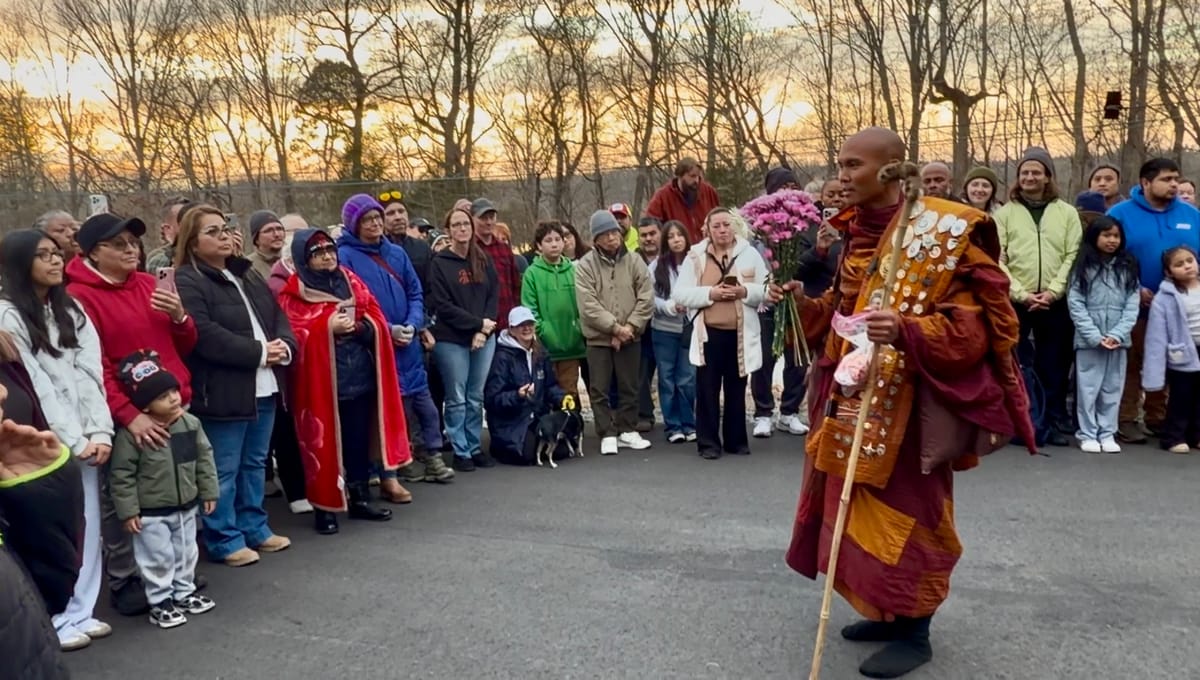
At their last stop somewhere north of Spencer, North Carolina, at the surreal site of the now forgotten York Hill Restaurant and Starlite Supper Club, my wife and I caught up with the Buddhist monks undertaking a historic months-long, 2,300-mile “Walk For Peace.”
It was a delight to huddle in a small crowd around their leader, the venerable Bhikkhu Pannakara. Though exhausted from a long day of walking, this plain-spoken (and surprisingly funny) monk made time to speak to us for 30 minutes straight. His words fell upon us like a salve for wounded souls. In a country, riven by political polarization and surging violence, these monks marching from their home in Ft.Worth Texas to Washington, DC, are touching hearts in ways I’ve never seen before. Along their path—through heat, rain, sleet and snow— I’ve seen children staring in wide-eyed wonder, grown men wracked by emotion, mothers smiling broadly with hope and tears of joy.
It’s no exaggeration to say that meeting these monks, at this perilous moment, has changed my life. When their walk is all said is done in a few days, many, myself included, will never forget them, or what they sacrificed for us.
They are teaching Americans a sublimely simple and profound lesson; that there is indeed a better way; a way to find inner and collective peace.
And so as a small act of gratitude, I thought it would be a good idea to share 10 lessons I took away from my close encounter with these remarkable humans:
1. March steadily, persistently toward your goal.
The lesson that made the biggest impression on me was the sight of these men marching at a speed of 3 to 4 miles per hour, all day. Day in. Day out. Though they faced frequent interruptions, like making ad hoc stops to greet adoring crowds, to have lunch (their only meal of the day), and to speak to admirers gathered to receive them at the end of each day’s journey, they kept going. They kept marching forward, never running, never rushing. Just a gentle, steady effort, daily. This is how a march of 20 or 30 miles a day becomes the vehicle for arriving at the finish line 2,300 miles away.
I ask myself: What if we had that same soft, steady, persistent march towards the single most important thing in our business—building human relationships? What would such remarkably consistent effort, day in and day out, do for our businesses?
2. Put generosity first.
I hate to say it. We live in a gimme, gimme, gimme society. The only reason to do anything for anyone else, it seems, is so we can get something from them in return. We hesitate to serve others unless they formally become our customers, which is to say that we only work if it's clearly understood that we require payment for that labor. Without that quid pro quo, we don't act.
The monks are showing us another way.
They didn’t start their plans by pondering pecuniary gain. Though, as their website clearly states, they do wish to expand their temple back in Ft. Worth and that costs a lot of money. Still, I've never once heard them ask for financial support along their Walk. In fact, their faith precludes them from such banal requests. Instead, they focused on a much more powerful and generous question: “How can we help the people?”
That was the animating question, or lodestar, that guided them along their perilous path. They sensed the immense suffering of many Americans and they sprung into action to serve, and hopefully relieve, some of that suffering. The lesson for solopreneurs is clear: Instead of asking permission to turn someone into our customer, why don’t we take the time to notice what they need, where they hurt, and simply start meeting that need or removing some of that pain. We need not sacrifice our selves or walk 2,300 perilous miles to be generous. Be we can show our abundant generosity in smaller ways. What if we stopped asking, "How can I get this person to buy from me?" and instead asked, "What is this person struggling with right now and what can I do to help them?"
3. Dare to be bold.
Another powerful impression was the sight of these 20 brown-skinned men, dressed in exotic Buddhist garb, trekking across the Southeastern United states; amid the ghosts and echoes of slavery and racial injustice. What, if not bold, is the spectacle of a band of Buddhist monks marching straight down main street in the nation’s Bible Belt; and, en route to the seat of global power in Trump's Washington, DC, to deliver a message of peace, while remaining unperturbed by the dangers they faced along the way. For some, it might be easy to see these monks as meek agents of peace but in reality, they are quiet revolutionaries. In fact, to describe what they’re doing as merely “bold” seems insufficient.
And it should not be lost on us that as revolutionaries of the best kind, their action is also disruptive.
Because of the growing crowds, the monks soon required police escorts, road closures, and safe places to stay, etc. Remarkably, they never asked for any of those resources, especially not at the outset, and they didn’t pay for them. They understood in their hearts that people are hungry for a revolutionary, but peaceful change, and that appealing to that deep desire for peace inside all of us would be enough to ensure the success of their venture. And whatever disruption they did cause, was not for their own gain but in the service of all people.
This is in stark contrast to the popular Silicon Valley notions of "disrupting" markets and entire industries, or of wreaking “creative destruction," too often for selfish gain alone. In contrast, the monks are builders, not destroyers. The disruption they caused were merely the ripples of kindness in what is otherwise often a brutal world.
We can learn from this. We can ask: How can I act boldly and confidently in the service of others? How can I spark a revolution or disruption in my industry, but not to merely upend the status quo for selfish reasons, or to enrich myself, but to accrue gains for others? What revolution can I launch today for the sake of the people I care about? It doesn’t cost you a penny to dream bigger about what our contribution could be.
In daring to be bold, the resources and people whose help we need will appear. We enrich our own lives when we’re willing to work for a purpose larger than mere self-interest; a purpose that ennobles everyone who comes into contact with it.
4. Go for it, even if you're not ready.
Let’s admit it. We often choose to think meekly about what’s possible for us simply because we've been led to believe that life is a zero sum game. This belief system posits that for some people to win, others must lose. It blinds us into seeing the truth, that life is actually an infinite game where the whole is far more than the sum of its parts.
Zero sum thinking is toxic to the human spirit because its focus is on scarcity. It leads us to fixate on all the things we think we need but don’t have. It tricks us into making excuses for not making our contribution. We say we lack the looks, the skills, the experience, the talent, the money, the assets, the power, the people. We let this focus on what we perceive as lacking stop us from pursuing ambitious ends.
But as Harvard Professor of Entrepreneurship, Howard Stevenson, has taught us, entrepreneurship is the pursuit of opportunity despite resources controlled. These monks are walking, talking examples of that kind of entrepreneurship in action. They saw an opportunity, prepared as much as they could, then headed out. Barefoot. They lacked so much of what they needed, but their conviction and mission were so strong that what they needed found them somewhere along the way. That’s entrepreneurship! This may sound woo-woo but having been a refugee early in life, possessing only the clothes on my body, I have come to believe that providence and good fortune smile on the bold, on those who walk with resolve, but who also walk with hope, spirit and love.
5. Stand up for what you believe.
There’s a lot of talk these days about resistance and ways that we can resist the Fascist takeover in our country. Color me skeptical. Personally, I don’t care for the word “resist” or “resistance”. It reminds me of my personal conviction that, “Whatever you resist, persists.” But, what if we resist by not resisting at all, like these humble Buddhist monks are doing.
The only thing these monks and Donald Trump have in common is an affinity for the color orange. But where trump speaks of hate for his enemies, of retribution, and revenge, of murderers, and rapists, of the worse of the worse, and “American carnage”, the monks I met talk softly of peace, love and kindness; they are daily seen honoring everyone’s humanity, humbling themselves to our shared spirit, calling for unity. Not once have I heard them speak of Trump. And this leads me to wonder, who might make the greater impact, the active resistors or those like these humble monks resisting by not resisting at all? No one can know. But even as I agree with historian, Kellie Carter Jackson’s assertion, that the idea of “non violent resistance isn’t wrong, it’s just incomplete,” these monks are reminding us of the radical power of staying on the sunny side of life and appealing to people’s better angels; and of resisting by standing for what you believe, instead of fighting fire with yet more fire. Instead of focusing on what we don’t want, what if opt to set our gaze upon what all human beings want: Freedom, Peace, Love, Compassion. What if we run and go tell that on the mountain?! What if we put those values into action?
6. Let your actions speak louder than your words.
I tend to overcomplicate everything, to overthink things, to try to come up with sophisticated answers and thus get hijacked by all the possible combinations and permutations for whatever it is I’m pondering. But not these monks. Their mission is simplicity itself. Walk. For. Peace. Those three simple words are the containers for everything else. Some of them walk barefoot. They eat just one meal a day. Some don’t speak at all and leave all the speaking to their leader, Bhikkhu Pannakara. They go to sleep relatively late and rise early to start their trek anew. Such simplicity and intensity of focus is inspiring to witness, and more than a little humbling. To make more of an emotional impact, the monks are letting their simple actions speak louder than their words.
But are we doings things the other way around? Are we all hat and no cattle, to quote an old Texan colloquialism? All talk and no action? How can we say less and do more? In other words, as the tried and true advice for fiction writers goes: how can we stop telling, and start showing.
7. Tell your story.
Simplicity does not imply a lack of sophistication or a penchant for naiveté. I see these monks as master storytellers and master distributors of those stories. I see some of them toting digital SLRs with long zooms. They have smartphones. They have a publicist and helpers who capture their adventures and sometimes livestream them. These monks understand the impact of visuals and words in crafting a good story in the modern world. And they invite the whole world to come along for the journey. They even have a cute mascot in the guise of a rescue dog they adopted in India during a similar pilgrimage. The four year old pup has a perfect heart-shaped tuft of white fur on his forehead. His name is Aloka (the Pali word for “light”). He’s also known as “The Peace Dog.” How perfect!
It’s obvious that the monks are master storytellers and marketers. They understand the power of a simple, cohesive, and visceral message. We can learn a lot from them in crafting the stories around our own work and our mission, and in using modern channels to distribute our message, that it may travel far and wide even in a noisy world.
8. Enroll others in the journey.
Consider the giant snowball. It starts out as an insignificant thing. But give it time to roll down the mountain and it becomes unstoppable. When the monks were in Texas, during the early days of their walk, they enjoyed no police escorts, no news camera crews following their every move. They walked alone, a band of misfits by the side of roads and highways on what may have seemed at times like a fool’s errand. That’s how great things are often born, as odd or insignificant, extraneous, or redundant things. But the monks stayed true and people started to notice. One told another, then another and attention snowballed until all of the world started watching. We caught up with the monks again in Greensboro, North Carolina, but this time it wasn’t a small, intimate crowd, there were thousands of people now. We had to park a mile away to catch but a glimpse.
The lesson?
What you try in your business may not work at first, but give it a fair chance. Stick with it. If it solves a real need it may still take a while to snowball, so don’t stop. Keep actively enrolling others to be part of your movement. Consider the plea that Bhikkhu Pannakara issues near the end of his talks to the masses of gathered admirers, “Will you walk with the monks for the rest of your life?”
9. Cultivate mindfulness and inner peace.
In every town they visit, the monks are imploring people to stop, get quiet, become mindful, focus on your breath.
“Put down your lover,” says Bhikkhu Pannakara. “Your lover is your cellphone,” he clarifies.
“Breathe,” he says. “We don’t have many more breaths left.”
Oftentimes, we think we need to add things to our life, to pack more information into our brains, in order to live a better life. So our minds become cluttered. Reactive. Discursive. We suffer from monkey mind and shiny object syndrome, not to mention impostor syndrome. The monks want us to know that we must search and cultivate inner peace before we can effectively build a more peaceful world, or business. Slowing down, focusing on our breath, and practicing mindfulness throughout the day is the key to a more peaceful life and more rewarding work. The monks are reminding us that life begins with the wail of our first breath and ends with the whimper of our last. Our breath in the present moment is all we have and we can learn to center ourselves there.
10. Accept and persevere.
This pilgrimage, which will soon come to an end in Washington, DC was not without tragedy. Back on November 11th, in the early days of the monk’s Walk for Peace, there was a horrible accident. A pick-up truck struck the monks’ escort vehicle which then ran over one of the monks while also hurting another. Bhante Dam Phommasan’s leg was so badly mangled that doctors had no choice but to amputate his foot and most of his lower leg.
“Before the walk I had a feeling that something like this might happen to either me or my friends, because walking around the roads is very dangerous,” said Phommasan to Atlanta News First. “But now I’m at peace with what has happened,” he added.
This was a dark and frightening time for the monks who discussed it and agreed that despite the setbacks and ongoing risk, the Walk should continue. They chose to persevere on their noble mission of peace, and risk their safety for the greater good. This inspired millions and something powerful was birthed from loss and grief.
“Before the accident the Walk for Peace movement was still unknown, but after my injury it sparked a lot of interest in many different communities and brought a lot of attention to not only Walk for Peace but to Buddhism as well,” said Phommasan.
Faith, acceptance, and perseverance kept the monks on their path despite this horrible chapter of their story. Fortunately, most of us won’t ever have to face such monstrous circumstances, but even if we do, we have the monk’s example of grace and resilience to light our path. Every day brings opportunities for us to practice perseverance and faith as we advance our mission.
Finally, perhaps the things we can learn from these courageous monks are countless. These ten are just a humble start. I have to confess to you that I’ll never forget Bhikkhu Pannakara and his brave monks who set out on a walk for peace in late 2025 and early 2026, from Ft. Worth Texas to Washington, DC; who risked so much for so many. I am forever thankful to them for reflecting back to us our desire for peace, love and compassion; for appealing to America’s better angels, for carrying a torch of hope during dark times. For all that and more, I will remember them as angels who walk among us. And I will try my best to walk with them for as many breaths as I have left. I share this story as a sort of prayer. My hope is that you too will walk with them too.